
NEWSROOM
-
ctDNA Methylation Monitoring Enables Earlier Detection and More Curative Treatment of Colorectal Cancer Recurrence After Surgery: Findings From the Phase III FIND Trial
For colorectal cancer (CRC) patients after surgery, follow-up has long relied on periodic imaging such as CT, passively waiting for a recurrence “signal” to become visible once the tumor has grown to a certain size. As a result, some patients miss the “window” for curative treatment of recurrence. On July 29, a multicenter prospective randomized phase III trial named FIND, led by Professor Junjie Peng of the Department of Colorectal Surgery and Professor Chunming Ding of the Department of Pathology at Fudan University Shanghai Cancer Center, achieved important progress. The results were published online in the Journal of Clinical Oncology (JCO), a top international oncology journal with an impact factor of 44.7. The study confirmed that for postoperative CRC patients, dynamic surveillance using ctDNA methylation can capture recurrence “signals” while recurrent lesions are still in their “budding” stage. Through timely and standardized treatment, the proportion of patients who receive curative-intent treatment after recurrence increased from 23.6% in the past to 48.1%, offering the prospect of transforming future follow-up models for postoperative CRC.
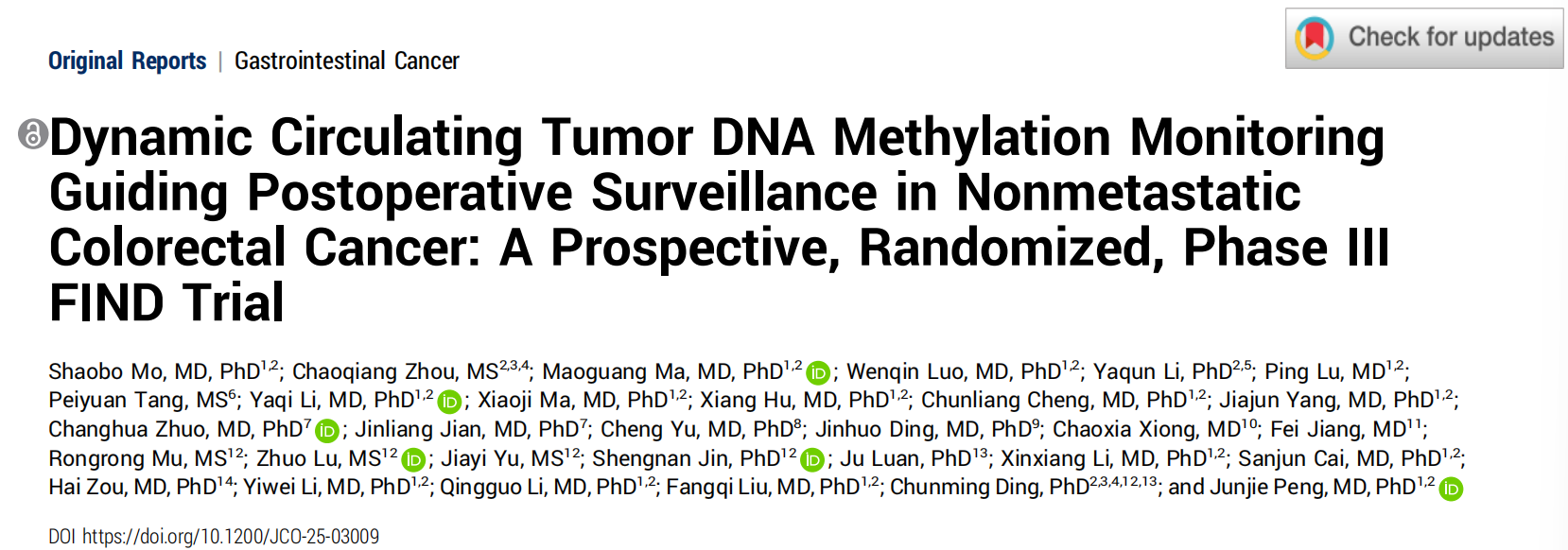
It is reported that for patients with stage I to III CRC who have undergone curative resection, the first two years after surgery represent a high-risk period for relapse, with the liver and lungs being the most common sites of metastasis, together accounting for 60% to 75% of all distant metastases. Once recurrence occurs, whether surgery, ablation, or other curative-intent local treatments can be performed directly determines long-term survival. “At present, the commonly used CT follow-up in clinical practice has limitations. Only when a tumor grows to a certain volume can it be visualized on imaging. By the time lesions are detected, many patients may have missed the ‘window’ for local curative treatment, or may only be eligible for maintenance palliative treatment, which greatly reduces efficacy and survival.” Prof. Peng pointed out this clinical dilemma of “passive waiting.”
To address this longstanding clinical challenge, the team led by Professors Peng and Ding launched a study named FIND. Between 2023 and 2026, a total of 584 postoperative CRC patients were enrolled and randomly assigned to a ctDNA surveillance follow-up group or a conventional CT follow-up control group. The ctDNA monitoring group used a highly sensitive methylation-specific PCR technique to track 10 tumor-specific methylation markers in plasma. Once a positive signal was detected, intensified imaging screening was immediately initiated. If imaging found no lesions, the CT re-examination interval was shortened to once every two months until two consecutive negative ctDNA results were obtained, after which the conventional follow-up rhythm was resumed. This dynamically adjusted strategy targets the high-risk window for recurrence and serves as an “early warning radar” for tumor recurrence.
Prof. Peng noted that previous global clinical trials involving ctDNA have mostly followed two paths: intensifying treatment for positive patients or reducing treatment for negative patients. The FIND study opened a new path. Rather than blindly increasing the intensity of systemic chemotherapy for ctDNA-positive patients, it relied on continuous biomarker monitoring to detect lesions while metastases were still oligometastatic and suitable for local curative treatment, thereby seeking a second chance at curative treatment. “We conducted this clinical study to verify that the value of ctDNA is not limited to adjusting drug regimens, but rather to build a new follow-up system of biological early warning, precise localization, and priority for local curative treatment. This is an exploration and innovation at the paradigm level.”
After two years of follow-up, the proportion of patients with recurrence who received curative-intent treatment in the ctDNA monitoring group reached 48.1%, an increase of 24.4 percentage points compared with 23.6% in the control group. In terms of detection timing, the median time to clinical recurrence in the monitoring group was 9.5 months, nearly 4 months earlier than 13.4 months in the control group, buying precious “window” time for curative-intent treatment.
The study further showed that for liver metastases, which occur frequently in CRC patients, metastases detected by ctDNA monitoring were more likely to be amenable to and suitable for curative surgery. Among these patients, 75% had fewer than 3 metastatic lesions, 90% had a maximum lesion diameter of 3 cm or less, and 80% had lesions confined to a single lobe. In the conventional follow-up group, these proportions were only 28.6%, 57.1%, and 28.6%, respectively. Meanwhile, the sensitivity of ctDNA methylation monitoring for predicting recurrence reached 84.1%, far higher than the 35.7% for the traditional tumor marker CEA.
Along with the publication of this original clinical research from China, it attracted widespread attention in the international academic community. Professor Eileen M. O'Reilly, Associate Editor of JCO and a researcher at Memorial Sloan Kettering Cancer Center in the United States, wrote a contemporaneous commentary specifically noting: “The data from the FIND trial using a ctDNA methylation assay provide intriguing support for proximate detection of recurrence in surveillance for CRC recurrence in a randomized trial. Mature survival results are awaited.”
“Our study answered a longstanding clinical question: whether a more sensitive monitoring method can translate into tangible treatment benefit. Our research confirms that the answer is yes,” Prof. Peng told reporters. ctDNA monitoring not only enables earlier detection of recurrence, but more importantly, it can capture oligometastatic lesions that still have curative potential. Although final long-term survival data still require continued follow-up validation, the current results send a positive signal. Looking ahead, ctDNA methylation monitoring is expected to be incorporated into standard postoperative follow-up for CRC, forming a dual-track model of “biomarker early warning plus imaging confirmation” and enabling individualized precision follow-up. Prof. Ding stated that highly sensitive and stably reproducible ctDNA methylation detection technology is the foundation for the smooth advancement of the FIND study. The technical platform established by the research team can stably capture trace amounts of residual tumor signals in the body and translate them into clear, actionable clinical decision criteria, connecting the translational chain from the basic laboratory to the clinical ward.
Dr. Shaobo Mo, first author of the paper and a physician in the Department of Colorectal Surgery, introduced that the monitoring rules designed in the study balance diagnostic and therapeutic effectiveness with the rational use of medical resources. “Intensive testing is initiated immediately upon a positive result, and follow-up frequency is reduced after two consecutive negative results. This dynamic and operable ‘Fudan model’ is suitable for promotion and application in medical institutions at all levels worldwide.”
