NEWSROOM
-
Fudan University Shanghai Cancer Center Study in JCO Offers Steroid-Sparing Antiemetic Strategy for the Immunotherapy Era
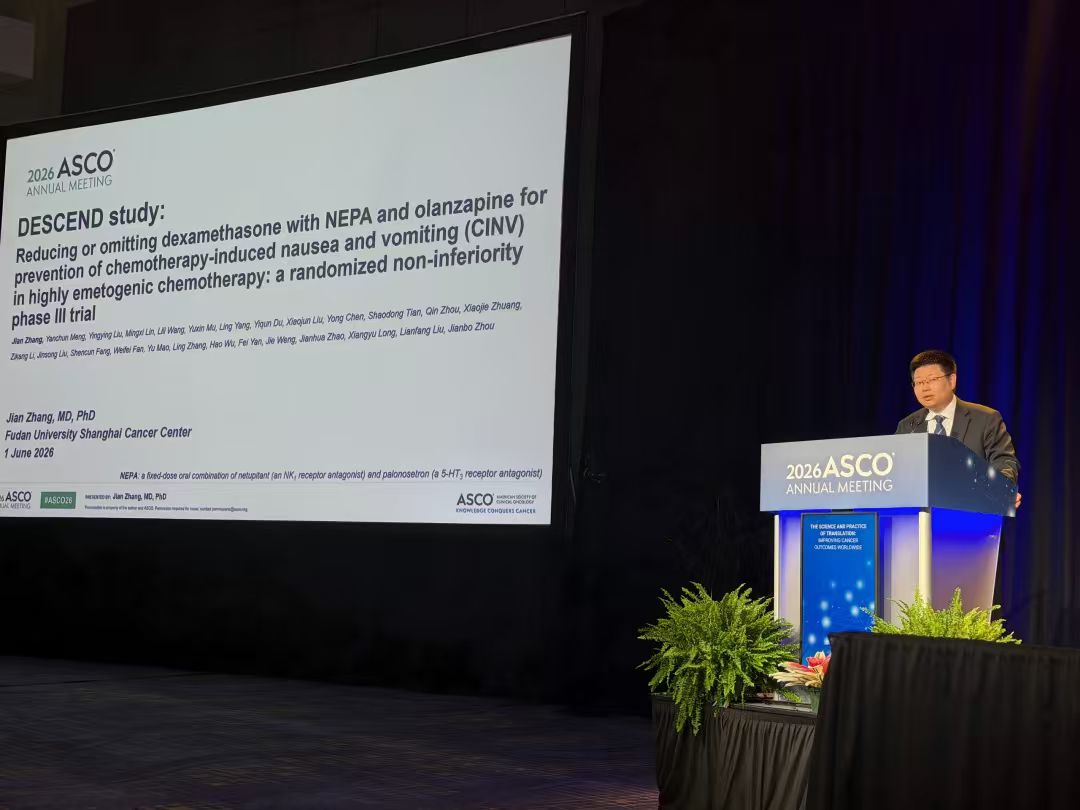
SHANGHAI — A nationwide, multicenter phase III trial led by Professor Jian Zhang, Director of the Phase I Unit at Fudan University Shanghai Cancer Center, has shown that reducing or even eliminating dexamethasone from standard antiemetic regimens does not compromise control of chemotherapy-induced nausea and vomiting (CINV) in patients receiving highly emetogenic chemotherapy (HEC). The DESCEND trial, conducted across 28 centers in China, was published in the Journal of Clinical Oncology (JCO; impact factor 44.7) and may help reshape standard supportive care in the chemo-immunotherapy era.
The study is an investigator-initiated trial (IIT) and one of the largest randomized efforts to address a longstanding clinical dilemma: how to maintain powerful antiemetic protection while avoiding the immunosuppressive and metabolic side effects of corticosteroids. Yanchun Meng, MD, Yingying Liu, MD, and colleagues are among the co-first authors. The results were previously presented at the 2026 ASCO Annual Meeting and have also been invited for featured presentation at the Antiemesis Study Group meeting of the Multinational Association of Supportive Care in Cancer (MASCC). This is another original IIT systemic therapy study from Fudan University Shanghai Cancer Center to be published in JCO, following the ABC regimen for brain metastases in triple-negative breast cancer.
As immune checkpoint inhibitors, antibody-drug conjugates (ADCs), and other novel therapies become standard in solid tumors, many are combined with HEC regimens. Current NCCN guidelines recommend a standard four-drug antiemetic regimen that includes four days of dexamethasone: 12 mg on day 1 and 8 mg daily on days 2–4. However, growing evidence suggests that even short-term corticosteroid exposure can inhibit T-cell function and antigen presentation, potentially weakening antitumor immunity. Dexamethasone can also cause insomnia, anxiety, hyperglycemia, and increased infection risk, with toxicities accumulating over repeated cycles. “How to reduce or even omit steroids while preserving antiemetic efficacy has become a core clinical challenge in the immunotherapy era,” said Prof. Zhang.
To address this, Prof. Zhang’s team launched the DESCEND multicenter, randomized, open-label, phase III noninferiority trial. A total of 644 adults receiving HEC were randomized 1:1:1. All patients received netupitant/palonosetron (NEPA) on day 1 plus olanzapine (OLZ) on days 1–4. The three arms were: standard dexamethasone (12 mg day 1, 8 mg days 2–4); dexamethasone-sparing (6 mg on day 1 only); and dexamethasone-free (no dexamethasone). The primary endpoint was complete response (CR), defined as no emesis and no rescue medication, from 0 to 120 hours after chemotherapy.
The trial met its primary endpoint. Overall CR rates were 72.4% with standard dexamethasone, 72.2% with the dexamethasone-sparing regimen, and 70.1% with the dexamethasone-free regimen. The stratified risk difference was −0.2% (95% CI, −8.7 to 8.5; P for noninferiority = .005) for dexamethasone-sparing versus standard, and −2.2% (95% CI, −10.7 to 6.4; P for noninferiority = .014) for dexamethasone-free versus standard. Both comparisons met the prespecified noninferiority margin of −12%, and per-protocol analyses were consistent. No significant differences were observed in secondary efficacy endpoints, including acute-phase, delayed-phase, and overall CR, complete protection, and total control.
“The safety and quality-of-life advantages of the new strategies were particularly notable,” Prof. Zhang noted. Compared with the standard regimen, both dexamethasone-sparing and dexamethasone-free arms had significantly lower incidence and severity of steroid-related adverse effects such as agitation/anxiety, hiccups, indigestion/heartburn, and insomnia. The dexamethasone-free regimen showed significantly lower severity for all five prespecified steroid-related side effects, while the dexamethasone-sparing regimen showed significant reductions for all except facial rash/acne.
Quality-of-life assessments showed that the dexamethasone-free arm had numerically lower rates of no impact on daily life during days 1–3, particularly in the nausea domain (approximately 51% on days 2–3 versus 64%–68% in the other arms), indicating slightly weaker early nausea control without dexamethasone. However, from day 4 onward, differences diminished, and by days 5–7, all three arms converged at approximately 80%. The dexamethasone-sparing arm closely tracked the standard arm throughout the 7-day period.
The findings suggest two practical strategies. For patients receiving chemo-immunotherapy, a single 6 mg dose of dexamethasone on day 1—reducing the traditional four-day course to one day and halving the day-1 dose—can maintain antiemetic protection while minimizing steroid exposure and potential immune interference. For patients with diabetes, glaucoma, psychiatric disorders, or prior intolerance to steroids, a dexamethasone-free regimen offers a viable alternative. The authors caution, however, that only 5.9% of trial patients received concurrent immunotherapy, and dedicated trials in chemo-immunotherapy and ADC-immunotherapy populations are needed. The dexamethasone-free approach may also require individualized nausea management, such as rescue medication or non-drug interventions, during the early delayed phase.
Looking ahead, Prof. Zhang said the team will continue to focus on precision supportive care in oncology. Future work will include validating steroid reduction and cessation strategies in prospective cohorts of patients receiving HEC plus immunotherapy, optimizing olanzapine dosing, incorporating non-pharmacologic approaches such as acupuncture, and developing dynamic, individualized antiemetic regimens based on patient response.
The publication of DESCEND marks a shift in CINV management for HEC from a “one-size-fits-all” approach of fixed doses and fixed courses toward precision stratification and individualized treatment. By reducing toxicity while preserving efficacy, the strategy offers a China-generated, evidence-based option for global supportive oncology and has the potential to improve both safety and comfort for patients with cancer.