
NEWSROOM
-
JCO+1! Fudan University Shanghai Cancer Center Provides New Basis for Precision Diagnosis and Treatment of Salivary Gland Cancer Patients (Ji Dongmei)
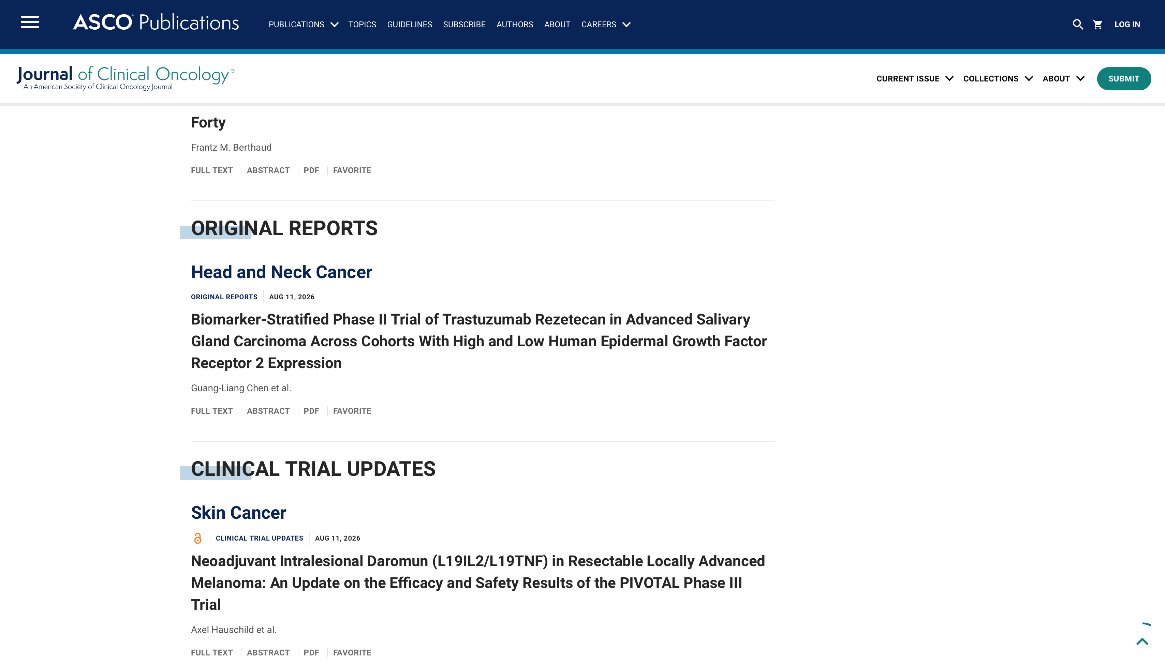
Salivary gland cancer is a highly heterogeneous rare malignancy, accounting for approximately 3% to 5% of head and neck malignancies, with over 20 pathological subtypes, making diagnosis and treatment extremely difficult. When the disease progresses to an unresectable, recurrent, or metastatic advanced stage, clinical systemic treatment options are very limited, and patient outcomes remain poor. On August 12, a prospective phase II clinical study, co-corresponding authored by Professor Ji Dongmei, Acting Director from the Department of Head and Neck Medical Oncology and Professor Ji Qinghai, Director of the Head and Neck Tumor Center, with Dr. Chen Guangliang and Dr. Guo Yanjin as co-first authors, was published online in the internationally top-tier oncology journal Journal of Clinical Oncology (Impact Factor 44.7). This study is the first to use a biomarker-stratified design to prospectively evaluate the efficacy and safety of the domestically developed HER2-targeting antibody-drug conjugate trastuzumab rezetecan (SHR-A1811) in treating advanced salivary gland cancer, providing new, high-quality evidence for HER2-stratified precision treatment for advanced salivary gland cancer. Results show that in the HER2-high expression group, over 90% of patients experienced significant tumor shrinkage; among HER2-low expression patients, previously considered to have "no target to hit," nearly half achieved remission.
Traditional chemotherapy for advanced salivary gland cancer yields an objective response rate of only 35% to 39%, with short duration of benefit; immune checkpoint inhibitors have an even lower efficacy rate of only 4.6% to 12%, failing to meet the treatment needs of advanced patients. HER2 is one of the few actionable targets in advanced salivary gland cancer, but globally, prospective clinical studies targeting this target in salivary gland cancer are extremely few, and relevant evidence is concentrated only in HER2-high expression populations. For the clinically significant proportion of HER2-low expression patients, whether they can benefit from HER2-targeted therapy has long lacked a clear answer, representing a core unresolved challenge in the treatment of advanced salivary gland cancer.
To address this clinical pain point, the Department of Internal Medicine of our hospital led this innovative clinical study, relying on the high-quality new drug research platform of the Clinical Research Center, and collaborating throughout with multiple disciplines including Head and Neck Surgery, Radiation Therapy Center, and Pathology. It innovatively adopted a research design of preset statistical hypotheses plus an umbrella biomarker stratification, the first prospective study in the salivary gland cancer field to use this stratification model, creating a high-quality evidence template for rare tumor clinical research. The study enrolled a total of 46 patients with HER2-positive advanced salivary gland cancer over two years, strictly dividing them into two independent treatment cohorts according to preset standards to achieve precise stratified treatment: the HER2-high expression group (IHC 3+, or 2+ with ISH positive) with 24 cases, and the HER2-low expression group (IHC 1+, or 2+ but ISH negative) with 22 cases. All enrolled patients uniformly received the domestically independently developed, approved HER2-targeting antibody-drug conjugate trastuzumab rezetecan (SHR-A1811).
As of March 5, 2026, the study completed a median follow-up of 17.9 months, and both cohorts successfully met the preset efficacy standards, with results of high clinical guidance value. HER2-high expression patients showed excellent efficacy, with an objective response rate of 91.7%, including 4 complete remission cases with complete tumor regression; disease control rate reached 95.8%, and median duration of remission, progression-free survival, and overall survival were not yet reached. The HER2-low expression group had an objective response rate of 45.5%, disease control rate of 95.5%, median progression-free survival of 12.7 months, and median overall survival of 21.3 months; both cohorts met the preset efficacy standards. In terms of safety, this study confirmed that trastuzumab rezetecan has generally good safety. The incidence of grade 3 or higher treatment-related adverse events was 41.3%, mainly hematological adverse events such as neutropenia, all of which are common and manageable clinically; the incidence of interstitial lung disease, of high clinical concern, was only 6.5%, and all cases were grade 1, with no severe adverse reactions and no new safety concerns.
"The core breakthrough of this study is that through rigorous stratified design, it fully explored the therapeutic value of trastuzumab rezetecan in advanced salivary gland cancer across the full spectrum of HER2 expression," stated Professor Ji Dongmei. "This study is a single-center, single-arm phase II clinical trial. Limited by the characteristics of rare tumors, the sample size is relatively limited, and the conclusions still require further validation and refinement by subsequent larger-scale, multi-center clinical studies. However, it is undeniable that this research published in JCO successfully answered a long-unresolved diagnostic and treatment challenge in the field of advanced salivary gland cancer, providing key new evidence for the first time for HER2 biomarker-stratified treatment of advanced salivary gland cancer, effectively filling the clinical gap in targeted therapy for HER2-low expression advanced salivary gland cancer, and expanding a new treatment direction for patients with this refractory tumor."

